Posted on Tue Jul 10, 2007 at 02:51:04 PM EST
Tags: (all tags)


Digby points out what we should all know by now; the Radical Religious Right is intolerant of religious beliefs not in lockstep with their own:
Liberal faith . . . ultimately morphs into societal and self-improvement efforts and jettisons the life-changing message of salvation, forgiveness of sins and a transformed life.If the newspaper story is accurate, this is where Clinton is on her faith: "In a brief quiz about her theological views, Mrs. Clinton said she believed in the resurrection of Jesus, though she described herself as less sure of the doctrine that being a Christian is the only way to salvation."
This is a politician speaking, not a person who believes in the central tenets of Christianity. . . . Clinton is entitled to whatever faith she wants to practice, but when she uses it as an election tactic, she should not be allowed to alter classic Christian theology.
If it is "classic Christian theology" that Cal Thomas is looking for, how about the Spanish Inquisition? It always makes me smile when Southern Baptists speak in this fashion. Cuz in the "classic Christian theology" - ole Cal Thomas is a heretic. I also wonder when ole Cal is gonna dissect Mitt Romney's Christianity.
(181 comments) Permalink :: Comments
Happy 5th blogiversary to Skippy the Bush Kangaroo. Skippy has made me smile with his unique writing voice all that time.
His blogiversary post reads like a Who's Who of the liberal blogosphere, so go on over and read it and check out the many blogs mentioned.
Congrats, Skippy, you've been a great blogosphere friend . I wish you many more great blogging years and hope you hit that 2 million mark soon.
In other blogging news, Heretik is doing a great job with Mike's Blog Roundup at Crooks and Liars. For those interested in the mechanics of blogging (such as the change-over of many individual blogs to group blogs and the concept of short head vs. long tail blogs) Chris Bowers explains all at the new blog Open Left in a post he titles, New Establishment Rising? The End Of the Flat BlogosphereArianna writes that Democrats can't wait for GOP'ers to defect to act to end the war.
Let's make this an open thread.
(19 comments) Permalink :: Comments
Posted on Tue Jul 10, 2007 at 11:42:57 AM EST
Tags: (all tags)
The AP reports that Senators Barack Obama and Hillary Clinton sparred on Iraq today. AP reports that Obama said:
It will be enormously difficult to invest in jobs and opportunity until we stop spending $275 million a day on this war in Iraq . . . I believed then and still do that being a leader means that you'd better do what's right and leave the politics aside, because there are no do-overs on an issue as important as war.
Fine to toot your horn but will it obfuscate the more important message? I think what Clinton said is the important message now:
Our message to the president is clear . . . It is time to begin ending this war — not next year, not next month — but today.
More.
(35 comments, 331 words in story) There's More :: Permalink :: Comments
Posted on Tue Jul 10, 2007 at 07:07:00 AM EST
Tags: (all tags)
On Monday in Los Angeles, David J. Bershad, a former partner at the huge class action law firm Milberg Weiss, until yesterday known as Milberg Weiss & Bershad, became the first principal of the firm to plead guilty in an investigation into kickbacks. Bershad, the law firm and another partner, Steven G. Schulman, were indicted last year. The investigation is continuing.
The 20-count indictment, which included conspiracy and other charges, detailed a scheme that began in the 1970s and continued as recently as 2005. In that scheme, lawyers inside Milberg Weiss paid $11 million in “secret and illegal kickbacks” to named plaintiffs in more than 150 class-action and other shareholder lawsuits. The lawsuits, according to the indictment, earned the firm more than $216 million.
Bershad, represented by Karl Rove lawyer Robert Luskin, pleaded guilty to conspiracy. He is cooperating with the Government.
Bershad could receive up to five years in prison. His sentencing date is set for June, 2008. Why is it so far away?
More...
(1 comment, 412 words in story) There's More :: Permalink :: Comments
I have an op-ed today in the Examiner newspapers taking to task those who criticized Live Earth, including Sir Bob Geldof, the British press and conservative bloggers. A snippet:
Yes, [Sir] Geldof, it was just a big pop concert. It won’t solve the energy crisis any more than your Live 8 concert ended poverty in Africa. But both are worthy endeavors.
Rock music is a great unifier. It transcends race, age, class and even politics. In today’s celebrity-driven culture, rock stars carry a lot of clout. To criticize them for using it to inspire positive change across society as they entertain us rings hollow.
The published piece omits the [Sir] which was in the version I submitted. I'm adding it back in here since I wouldn't have called Bob Geldof out only using his last name. Seems kind of rude.
Update: The AP Style people, Wikipdedia and commenters below point out that "Sir Geldof" would not be a correct appellation. I stand corrected, but again, I meant no disrespect to him.
(30 comments) Permalink :: Comments
Posted on Mon Jul 09, 2007 at 11:33:01 PM EST
Tags: Libby Trial (all tags)


The House Judiciary Committee has announced the list of witnesses for Wednesday's hearing on "The Use and Misuse of Presidential Clemency Power for Executive Branch Officials.
Via TP Muckraker and Sentencing Law & Policy:
- Ambassador Joseph Wilson
- Roger Adams, US Department of Justice Pardon Attorney
- Douglas A. Berman, William B. Saxbe Designated Professor of Law, Moritz College of Law, The Ohio State University
- Tom Cochran, Assistant Federal Public Defender, Middle District of North Carolina (Attorney for [sic] Vincent Rita, Rita v. US)
- David Rifkin, partner, Baker & Hostetler LLP, former Justice Department official during the Reagan and Bush Sr. administrations.
TP Muckraker quotes Rep. John Conyers on the purpose of the hearing:
"Congress must now look into presidential authority to grant clemency, and how such power may be abused. Taken to its extreme, and possibly in the case of the Libby clemency, the use of such authority could completely circumvent the law enforcement process and prevent credible efforts to investigate wrongdoing in the executive branch."
While I'm pleased Joe Wilson and Prof. Berman, who writes the excellent Sentencing Law & Policy blog are going to be witnesses, I'm concerned that the committee will not be hearing from anyone involved in the Libby commutation process.
There was no clemency petition, the Pardon Attorney was kept out of the loop and I just don't see how these witnesses will shed any light on whether Bush's motive for granting the clemency was proper or improper.
More...
(8 comments, 988 words in story) There's More :: Permalink :: Comments

Karl Rove was in Aspen this weekend for the Aspen Ideas Festival. He spoke and answered questions about a range of issues from Iraq to Guantanamo and the leak of former CIA Agent Valerie Plame's identity. His role as Bush's water-carrier continues.
On Gitmo:
"It may not be Gitmo," Rove said about where the prisoners might go. "But it's going to be the brig in Charleston, South Carolina. Or it's going to be the Pitkin County Jail. Or the Florence, Colorado maximum-security facility. We've got to hold them somewhere. These are bad people. These are people who threatened the United States of America."
As Rove tells it, the biggest problem at Guantanamo is weight gain.
On his role in the CIA leak:
(4 comments, 279 words in story) There's More :: Permalink :: Comments
Posted on Mon Jul 09, 2007 at 08:08:38 PM EST
Tags: Libby Trial (all tags)
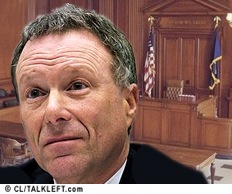
The briefs are in and both the Government and Team Libby, as well as White House Counsel Fred Fielding who submitted a letter, agree: Libby's two year term supervised release is valid and he should begin serving it immediately.
Fitz's brief is here (pdf), Libby's is here, and Fred Fielding's letter (which he sent to both sides and filed with the court even though neither side took Judge Walton up on his suggestion and asked for the White House's opinion) is here.
I'd say it's a done deal. Libby will be on supervised release before the week is out.
For what supervised release means for Libby, see my earlier post, Life on Supervised Release. For TalkLeft's analysis of the issue of the validity of the supervised release term in light of the commutation see Suggestions for Judge Walton on Libby's Supervised Release.
(10 comments) Permalink :: Comments
Say hello to Matt Stoller, Chris Bowers and Mike Lux' new blog, Open Left.
It already has a thumbs up from Digby and Jane Hamsher.
What's it about? Matt Stoller explains here.
Mostly, its "trying to bring progressive activists and professionals from 'inside' and 'outside' the political establishment into regular, thoughtful, and active connection with one another."
I'm all for that, go on over and check it out.
(3 comments) Permalink :: Comments
Posted on Mon Jul 09, 2007 at 06:32:02 PM EST
Tags: (all tags)
Paul Kiel goes through some of the basics with law professors Lederman and Turley.
First question, can Sara Taylor testify in spite of the WH's "direction" on executive privilege (note: I think the question is backwards, can Taylor NOT testify based on that direction. I say no.):
First, although the president has "directed" Sara Taylor, Karl Rove's former aide, and Harriet Miers, the former White House counsel, not to testify, the decision is still up to them, both said. Although the traditional expectation is that aides will comply with determinations of executive privilege by the president, both could still refuse. It would be a "career ending move" to be sure, Turley added, but there is no legal impediment.
Honestly, I do not agree with the notion that a former aide can rely on a "direction," which seems to be the implication of Turley and seemingly, Lederman. I think the proper course is this:
Even if Taylor decided to defy the president's direction and testify, the White House would surely seek to bar her testimony in court through a restraining order, an injunction, or some other means, both experts agreed.
Precisely. It is up to the WH now to assert its privilege. Taylor has no privilege to assert. More.
(3 comments, 630 words in story) There's More :: Permalink :: Comments
Posted on Mon Jul 09, 2007 at 06:01:17 PM EST
Tags: Dick Cheney (all tags)
Cheney's personal favorability rating according to NYTimes polling.
Honestly, I am skeptical. That number seems impossibly low.
In any event, if that is not exciting enough, watch me take on the Beltway Elite (not really, it's our friend Conn Carroll of the Blogometer) on all things Netroots, Iraq and politics.
(13 comments) Permalink :: Comments
Posted on Mon Jul 09, 2007 at 12:32:16 PM EST
Tags: (all tags)
Another upshot of this is that debates about impeachment are purely about the politics -- obviously there's no chance of 2/3 of the Senate voting to convict anyone. And here I also agree with Ezra that here McArdle is considerably more persuasive. It's hard to see how serious impeachment proceedings (as opposed to stepping up use of Congress' oversight powers in general) would strengthen the Democrats' political position.
And Ezra:
Incidentally, I actually agree that impeachment proceedings would be a Bad Idea . . .
But this part of Ezra's post really interests me:
The Democrats were elected on one of the clearest agendas in modern times: Drawing down the Iraq War, passing anti-corruption legislation, and instituting a series of popular, if small, pieces of economic populism (increase in the minimum wage, Medicare bargaining, etc). Bush has stymied every one. . .
On Iraq, it is the Democrats who can stymie Bush, if they will use their Constitutional authority. Will no one join me in urging the Congress to stymie Bush on Iraq?
(83 comments) Permalink :: Comments
| << Previous 12 | Next 12 >> |