Financial Times reports on Charles Graner's defense and says it crumbled today when the Court wouldn't allow the jury to hear from his "expert." According to other foreign news accounts of the trial , Thomas Archambault, a "self-styled prisoner restraint expert" told the judge outside the presence of the jury that Graner used "good foresight" and that the stacking of prisoners was a "creative technique."
A witness at the trial of the alleged Abu Ghraib prison abuse ringleader hailed the stacking up of naked detainees as "a creative technique" and said he too would have photographed it. The strongest testimony in favor of the military policeman was not presented before the jury as the judge ruled after hearing it that it was not relevant.
Thomas Archambault, a self-styled prisoner restraint expert, said Graner, had "used good foresight" in the way he dealt with the detainees. He said piling the naked prisoners on top of each other was "a very creative technique," but admitted it did not appear in any training manual. In questioning the witness, defense lawyer Guy Womack referred to the human stack as "a cheerleader pyramid."
(37 comments, 371 words in story) There's More :: Permalink :: Comments
I've now participated in blogger conference calls with both Simon Rosenberg and Howard Dean. They are my two favorite candidates for Chair of the DNC. Both appreciate the importance of grass roots activism and the ability of the Internet to empower people and bring them into the political process. Both emphasize the importance of diversity and the politics of inclusion. Both stress the need to focus on local and state political races and organizations.
Until the call with Dean today, I had expected that he would be more focused on issues or the Democratic message while Rosenberg would be more into the technology and organizational structure. Not so. Both believe that the role of the DNC chair is not to establish policy but to create the machinery that will win elections.
My question to Dean today was along the lines of:
I see the difference between you and some of the other candidates as being your willingness to advocate progressive positions on issues. Other candidates have said the DNC Chair job is mostly about increasing our technological and organizational abilities. Do you think we can win elections if we don't focus on the issues? How important is it for the DNC Chair to speak out on the issues?
I had expected him to say it was important to remind Democrats of our progressive positions on issues. But, I was wrong. He said,to paraphrase,
(22 comments, 560 words in story) There's More :: Permalink :: Comments
The Supreme Court today issued an important decision upholding the rights of immigrants who have been ordered excluded from the U.S. but whose home country won't take them back. It rejected the Government's arguments that it could detain them indefinitely. The ACLU, which filed an amicus in the case, has more:
The Supreme Court today ruled 7-2 that the government violated the law by indefinitely detaining “Mariel” Cubans who cannot be deported because Cuba will not allow their return.
“Once again, the Court has rebuked the administration for claiming the authority to indefinitely imprison immigrants,” said Judy Rabinovitz, a senior staff attorney with the ACLU Immigrants’ Rights Project and an author of the ACLU’s friend-of-the-court brief who has successfully argued against such policies in the lower courts. “Today’s ruling is a vindication of the ACLU’s position that the government has been violating immigrants’ rights in disregard of the Supreme Court’s 2001 decision prohibiting indefinite detention.”
(11 comments) Permalink :: Comments
An editorial in the Houston Chronicle discusses Charles Graner's defense attorney Guy Womack,saying we should not discount his powers of persuasion, and gives some examples from his colorful past:
As an assistant U.S. attorney in Houston in 1996, he helped market a device to school districts and law enforcement agencies called the Quadro Tracker. It was advertised as a high-tech divining rod that used chips to activate an antenna that supposedly could track down missing people and discover drugs, weapons or other contraband. More than 1,000 of the devices were sold around the country for as much as $8,000 each.
In reality, the device was simply an antenna attached to an empty plastic box. A federal judge ordered the manufacture of the Tracker halted, and the FBI denounced it as a hoax. Prosecutors investigated Womack's role in marketing the device and he eventually resigned his federal post and paid a $5,000 settlement while denying any wrongdoing.
After giving another example, the Chronicle concludes:
Before military prosecutors chuckle at Womack's tactics, they might consider this: A lawyer who could market $8,000 divining rods to street-smart lawmen just might be able to sell Specialist Graner as a cheerleader in uniform to a military jury.
[hat tip KMC)
(4 comments) Permalink :: Comments
The Hill reports that John Kerry is reaching out to candidates for the Democratic National Committee Chair and asking them "to be neutral" with respect to 2008. The Hill says Kerry is signaling his intent to run in 2008.
Kerry's stepson, Chris Heinz, endorsed Simon Rosenberg for DNC Chair. So has former Dean campaign manager Joe Trippi. The article says Kerry has not contacted Rosenberg, but his conversations with Howard Dean have increased. The article says strategists put Dean as the front runner.
I was on a blogger conference call with Mr. Rosenberg last week and was very impressed. Later this afternoon I'll be on a similar blogger conference call with Howard Dean. I'm undecided at this point - but very grateful to Blogpac for putting together these calls with the candidates.
The vote is February 12.
Much like House leadership races, every declared candidate will be on the first ballot, with the list winnowing by one with each round of balloting.....The candidates are continuing to contact the 447 DNC members who have a vote, with several candidates claiming to have spoken with more than 200.
(20 comments) Permalink :: Comments
This can't be good for Charles Graner, who began the defense portion of his trial today on charges he abused prisoners at Abu Ghraib prison in Iraq. His defense witnesses are scoring points for the prosecution:
Army Spc. Charles Graner had a habit of disobeying orders from his military police superiors while serving as a guard at Abu Ghraib prison, according to testimony Wednesday from the first witness for the defense.
Master Sgt. Brian Lipinski, then the top noncommissioned officer in the 372nd Military Police Company, said under cross-examination that Graner wore his hair too long, altered his uniform in violation of regulations and refused to stay away from Pfc. Lynndie England despite being repeatedly told to do so.
"He just didn't like to follow orders," said prosecutor Maj. Michael Holley asked Lipinski. "That's true, sir," Lipinski said. "He wants to do his own thing?" Holley said. "Yes, sir," the sergeant responded.
It gets worse for Graner:
(16 comments, 306 words in story) There's More :: Permalink :: Comments
So who can seek relief after today's decisions in Booker and Fan Fan? And will they get anything? I hate to dash hopes, but my intial impression is that it doesn't look very promising for the vast number of defendants out there, although there will be a lot of litigation engendered by the decision. Justice Breyer writes for the Court:
As these dispositions indicate, we must apply today's holdings--both the Sixth Amendment holding and our remedial interpretation of the Sentencing Act--- to all cases on direct review. See Griffith v. Kentucky, 479 U. S. 314, 328 (1987) ("[A] new rule for the conduct of criminal prosecutions is to be applied retroactively to all cases . . . pending on direct review or not yet final, with no exception for cases in which the new rule constitutes a 'clear break' with the past"). ....
(5 comments, 371 words in story) There's More :: Permalink :: Comments
Some thoughts on a first read of the opinions:
Justice Stevens opinion contains the legal conclusion affirming the Court's prior ruling in Blakely and explains why judges may not increase sentences beyond what the guidelines call for based on facts not submitted to the jury. (Shorthand reason: it violates the 6th Amendment right to have a jury decide guilt beyond a reasonable doubt since judges use a lesser standard of preponderance of the evidence).
Justice Breyer's opinion discusses whether the Guidelines can be saved or must be scrapped - the remedy, if you will. First, the decisions invalidate only two provisions of the Sentencing Statute: They are 18 USC Sec. 3553 (b)(1) and 3742(e). The first makes the guidelines mandatory and the second relates to the standard of review for appeal of departure rulings. [From now on, the standard of review for reviewing departures will be the standard of 'reasonableness' instead of 'de novo'.]
(1 comment, 976 words in story) There's More :: Permalink :: Comments
The Supreme Court ruled today in the Booker and Fan Fan cases and the validity of the U.S. Sentencing Guidelines. [scroll down for links to opinions] In Booker (the case in which the defendant is represented by TalkLeft's contributing blogger TChris, who also argued the case before the High Court), the Court ruled against the Government and in favor of TChris's client. Congratulations, TChris.
Justice Stevens opinion addresses the first question on appeal, whether Blakely should be affirmed, and the Court agrees it should. Justice Breyer answers the second question as to whether the Guidelines are constitutional. Essentially, they aren't, but the invalid parts can be excised and the remainder can stay as advisory but not mandatory.
The Supreme Court ruled Tuesday that federal judges have been improperly adding time to criminals' sentences, a decision that puts in doubt longtime sentencing rules. The court, on a 5-4 vote, said that its ruling last June that juries - not judges - should consider factors that can add years to defendants' prison sentences applies as well to the 17-year-old federal guideline system.
The justices refused to backtrack from a 5-4 decision that struck down a state sentencing system because it gave judges too much leeway in sentencing. But the high court stopped short of striking down the federal system.
So what are the implications for everyone else? Justice Breyer in his opinion said the Guidelines are not mandatory, but Courts must consider them when sentencing. I'll add the link to the opinions as soon as they are in, but here's the gist of the rulings from Scotus Blog:
(14 comments, 643 words in story) There's More :: Permalink :: Comments
Michael Tigar has finished his two day closing argument in the Lynne Stewart trial. The prosecution began its rebuttal closing Tuesday and the jury should get the case Wednesday:
Michael Tigar, finished his closing argument on behalf of civil rights lawyer Lynne Stewart by saying he feared Islamic or other fundamentalists were going to win -- but not through usual means. He said the authors of the Bill of Rights were "not cowards," and he portrayed his client as a hero for more than 30 years of work on behalf of people who were often destitute or despised.
"Suppose we got so worked up, so incited by the rhetoric of government, that we decided to punish people for their radical politics because their politics scared us or their religious doctrine appalled us," he said.
Tigar said such an attitude might cause people to "skip over reasonable doubt and do things based on suspicion," casting aside the presumption of innocence. "If all that happened, members of the jury, the fundamentalists would have won," he added. "They would have seen extinguished the light of this last hope of earth, which is not some particular country, but it is the very ideology of human rights." He said such a result would be cheered by Islamic fundamentalists.
What's really at stake in the Lynne Stewart case? Your constitutional right to effective assistance of counsel. Your right to zealous representation by the counsel of your choice. Your right to speak to your attorney in confidence, without the Government listening in.
(8 comments, 629 words in story) There's More :: Permalink :: Comments
The prosecution rested today in the perjury trial of discredited Texas drug undercover cop Tom Coleman, who is charged with stealing gasoline from the county and lied about it.
The hearing in which Coleman is accused of making false statements dealt with the Tulia drug busts, in which he was the key witness, but the charges against him do not relate to those now-discredited convictions. Coleman was accused of taking upwards of 100 gallons of gas from a pump used by county vehicles in Morton while driving a pickup truck that was not a county vehicle.
"The significance of the cost of the gas isn't what's important," special prosecutor Rod Hobson said. "It's that he stole the gas and lied under oath and then made a second lie about when he knew charges were filed."
Grits for Breakfast has the latest live-blogging installment of the trial here.
Following our morning update, the Government presented the videotaped testimony of Iraqi prisoner Hussein Muttar. More of the same, except that Muttar added that the torture by the Graner gang was worse than the torture administered by Saddam Hussein.
The prosecution has rested. The defense begins presenting its case tomorrow, presumably including Graner's testimony.
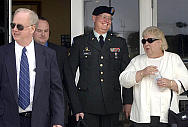
Graner, meanwhile, is still yukking it up outside of court. Here's a photo of Graner and his parents leaving Court during a recess today.
(30 comments) Permalink :: Comments
| << Previous 12 | Next 12 >> |