How's this for an attention deflector?
Both the FBI and CIA are calling it the first case of espionage in the White House in modern history. Officials tell ABC News the alleged spy worked undetected at the White House for almost three years. Leandro Aragoncillo, 46, was a U.S. Marine most recently assigned to the staff of Vice President Dick Cheney.
Aragoncillo was caught last year, arrested a month ago and began cooperating. Why break the story today? Did he steal secrets and give them to the Russians? Not quite.
Officials say the classified material, which Aragoncillo stole from the vice president's office, included damaging dossiers on the president of the Philippines. He then passed those on to opposition politicians planning a coup in the Pacific nation.
(24 comments) Permalink :: Comments
Posted on Wed Oct 05, 2005 at 03:48:20 PM EST
Tags: (all tags)
Bump and Update: The DC Rumor Mill says 22 Indictments are about to be handed down in the Plame investigation:
The D.C. Rumor mill is thrumming with whispers that 22 indictments are about to be handed down on the outed-CIA agent Valerie Plame case. The last time the wires buzzed this loud — that Tom DeLay would be indicted and would step down from his leadership post in the House — the scuttlebutters got it right.
Can it be a coincidence that the White House appears to be distancing President Bush from embattled aide Karl Rove? “He’s been missing in action at more than one major presidential event,” a member of the White House press corps tells us.
And just in time, Arianna has a new Judy Miller blog roundup.
*****
Original Post:
Daily Kos and AmericaBlog say Karl Rove has been absent from many recent White House events and wonder why. Is he expecting bad news from Fitzgerald and being put in time out so Bush can distance himself from him?
(15 comments) Permalink :: Comments
by TChris
Roy Blunt, who took over as House majority leader for the twice-indicted Tom DeLay, turns out to be DeLay's mini-me.
Tom DeLay deliberately raised more money than he needed to throw parties at the 2000 presidential convention, then diverted some of the excess to longtime ally Roy Blunt through a series of donations that benefited both men's causes.
When the financial carousel stopped, DeLay's private charity, the consulting firm that employed DeLay's wife and the Missouri campaign of Blunt's son all ended up with money, according to campaign documents reviewed by The Associated Press.
Why is this significant?
(7 comments, 399 words in story) There's More :: Permalink :: Comments
Posted on Wed Oct 05, 2005 at 12:20:30 PM EST
Tags: (all tags)
New York Times reporter Judith Miller gave her first post-jail interview last night to Lou Dobbs on CNN. Crooks and Liars has the video.
Here's Judy the martyr (from the transcript, available on Lexis.com):
You know, Lou, I knew and I know they wasn't covering for anybody. I was protecting the confidentiality of the source to whom I had given my word. I was keeping my word. And until I knew that that source genuinely wanted me to testify, and I heard that from him, I was willing to sit in jail. I didn't want to be in jail, but I knew that the principle of confidentiality was so important that I had to, because if people can't trust us to come to us to tell us the things that government and powerful corporations don't want us to know, we're dead in the water. The public won't know....That's why I was sitting in jail. For the public's right to know.
(6 comments, 955 words in story) There's More :: Permalink :: Comments
We haven't had one of these in a while and I need to get back to work. Have fun.
(17 comments) Permalink :: Comments
Via NPR:
A federal court in New York has ruled that the Salvation Army may hire and fire employees according to their religious beliefs -- even though it receives most of its money for social services from the government. The ruling earlier this week is considered a major court victory for the Bush administration.
[Hat tip to The Heretik]
(22 comments) Permalink :: Comments
Raw Story reports that the mainstream press has yet to pick up on the fact that Senators Brownback, Lott and Warner are all suddenly challenging Frist's control of the Senate -- which may spell trouble down the road.
What was once a hairline fracture in party cohesion is now a broken bone. Whether Republicans in Congress can reform a disciplined cavalcade behind the party’s agenda and its leadership – as the Democrats did on Social Security – may be the difference between holding onto the presidency and Congress and losing control in the years to come.
Also, the Gang of 14 is meeting at 4:30 today.
(11 comments) Permalink :: Comments
Via Sentencing Law and Policy and How Appealing, comes more evidence that Harriet Miers has long been a strong supporter of legal services to the poor. Professor Berman asks:
These issues are, of course, interesting as a matter of criminal justice policy, but they are also potentially significant as a matter of constitutional doctrine. More than a few academics have forcefully advocated that some indigent defense systems are per se constitutionally ineffective because of a lack of adequate funding. Might a Justice Miers be more sympathetic to claims of this sort — or ineffective assistance of counsel claims more generally — than some of her future colleagues?
Related post on published letter on the topic here.
(2 comments) Permalink :: Comments
This is an incredibly engrossing and important article from Der Spiegel on Abu Ghraib. It's very long, so you might want to bookmark it or print it out for when you have time to read the whole thing. By putting the story in the personal context of Jamal Davis, the prison guard, and Hajj Ali, a prisoner and Iraqi community leader, and showing how both of their worlds were destroyed, it brings the horror of what U.S. soldiers did there into much sharper focus.
There are new details of the pervasive sadism of the U.S. prison guards and the higher-ups who endorsed it.
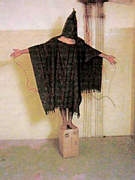
Hajj Ali believes he is the one in this picture.
"How can it be," he asks, "that the victims are not being called as witnesses, that no one wants to hear their version of the story? How can it be that someone like Davis gets only half a year in prison?" "Davis and the others," he says, "killed our souls."
(21 comments, 399 words in story) There's More :: Permalink :: Comments
(10 comments) Permalink :: Comments
Tom DeLay may have the best lawyer around, but he's shooting himself in the foot. He needs to stay off the airwaves. The latest:
In his radio comments on Tuesday, Mr. DeLay offered a new insight on the case, saying he made a mistake in a voluntary interview with the prosecutor's office a few weeks ago that helped prompt the indictments.
He would not discuss his mistake in detail, but it apparently concerned the $190,000 check that is central to the case. Mr. Earle charges that the money, which included money from corporate interests in Texas, was turned over to the Republican National Committee with instructions to return $190,000 to designated candidates for the Texas Legislature. The accusation is that the transaction was intended to circumvent a prohibition on the use of corporate money in state races.
(7 comments, 312 words in story) There's More :: Permalink :: Comments
Many of the quotes the White House is using to persuade conservatives that Harriet Miers is one of them seem to be coming from Texas Supreme Court Judge Nathan Hecht, who describes himself as a 30 year friend and sometimes date of Ms. Miers. He was a junior colleague at the law firm she co-managed, and according to him, in large part responsible for her conversion to born-again Christianity.
The White House included Hecht on at least one of the conference calls it conducted Monday to shore up support for Miers Monday.
(9 comments, 359 words in story) There's More :: Permalink :: Comments
| << Previous 12 | Next 12 >> |