It's a great day for justice. In addition to the al-Marri decision (blogged here), we learn that Genarlow Wilson, who TalkLeft last wrote about here, has been ordered released from his 10 year sentence for having consensual oral sex with a girl who was only two years younger. If Georgia prosecutors had any humanity, they wouldn't appeal the decision, but an appeal seems likely, and it may keep Wilson behind bars pending the outcome.
(16 comments) Permalink :: Comments
Even the conservative Fourth Circuit (or at least a divided panel on that conservative court) agrees that the Bush administration can't arrest someone who is in the United States, declare him an enemy combatant, and hold him indefinitely without trial.
The court said sanctioning the indefinite detention of civilians would have "disastrous consequences for the constitution — and the country."
The court's lengthy opinion (pdf) tells the story. TalkLeft background on the detention of Ali Saleh Kahlah al-Marri is collected here.
(16 comments) Permalink :: Comments
Posted on Mon Jun 11, 2007 at 12:33:28 PM EST
Tags: (all tags)
Matt Stoller and David Sirota lay into the Beltway Elite on their analysis of the Iraq Supplemental. Stoller lambastes Stu Rothenberg's thinking:
Why take a chance alienating swing voters, Rothenberg asks, completely oblivious to the fact that this vote cost Democrats ten points among independents. We're already seeing rural voters turn against the occupation, and towards the Democrats. . . . Note also the contempt for the left, for people who want to end the occupation in Iraq. Where are we going to go, if it's not for Mark Udall in Colorado or Hillary Clinton in 2008? Well, I can say that this energy is going to translate either into primary challenges or into apathy, but it won't go into helping this party leadership much longer. I'm going to encourage primaries as much as possible, because what they want is for us to go away. . . .
Good for Matt. Sirota takes on the Beltway Dem class:
(32 comments, 804 words in story) There's More :: Permalink :: Comments
Received by email, news that the Supreme Court granted certiorari in two sentencing case to replace Claiborne, which (as TalkLeft noted here) was rendered moot when Claiborne was shot to death.
Kimbrough v. United States, Case No. 06-6330 was a crack case in which the 4th Circuit reversed per curiam the defendant's below-range sentence, holding that "a sentence that is outside the guideline range is per se unreasonable when it is based on a disagreement with the sentencing disparity for crack and powder cocaine offenses," see United States v. Kimbrough, 174 Fed. Appx. 798 (4th Cir. 2006).The Supreme Court also agreed to hear another case out of the 8th Circuit raising the same issue that had been raised by Claiborne: whether a court must have "extraordinary justifications" in order to impose an "extraordinary" below-range sentence. The case is Gall v. United States, No. 06-7949, and the 8th Cirucit's opinion can be found at United States v. Gall, 446 F.3d 884 (8th Cir. 2006).
(6 comments) Permalink :: Comments
The Connecticut Assembly and Senate passed a bill that permits people suffering from certain health conditions to grow their own marijuana. It isn't clear whether Gov. Rell will sign it.
"In the past, she has been sympathetic to helping the terminally ill and those with debilitating symptoms find relief," [spokesman Rich] Harris said, "but she would frankly prefer to see the policy change at the federal level since it is a chronic problem for any state that takes up the issue."
We'd all prefer to see the federal government do the right thing, but state action is the best way to make that happen. When enough states have legalized medical marijuana, federal legislators will get the message. Sometimes it takes a personal tragedy to bring them around.
State Representative Marie Lopez Kirkley-Bey, a Democrat from Hartford who is deputy speaker, said she had been “vehemently opposed” to the legalization of marijuana for medical purposes and voted against such bills in the past because she feared a negative impact on children. But she changed her mind when two of her cousins died of cancer last year.“When I saw the pain and suffering they endured while trying to maintain their dignity and composure, the bill came to my mind,” Ms. Kirkley-Bey said. “There was a feeling that before, I didn’t do the right thing.”
It's never too late to do the right thing. Gov. Rell should sign the bill.
(42 comments) Permalink :: Comments
Here's Colin Powell making sense.
"If it was up to me, I would close Guantanamo. Not tomorrow, but this afternoon. I'd close it," he said."And I would not let any of those people go," he said. "I would simply move them to the United States and put them into our federal legal system. The concern was, well then they'll have access to lawyers, then they'll have access to writs of habeas corpus. So what? Let them. Isn't that what our system is all about?"
More ...
(6 comments, 171 words in story) There's More :: Permalink :: Comments
Posted on Sun Jun 10, 2007 at 08:13:42 PM EST
Tags: Sopranos (all tags)
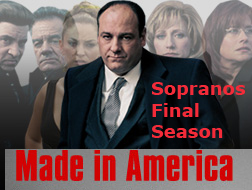
The last episode of the Sopranos. It all ends tonight.
Were you satisfied?
Monday Update: I hated it. I watched it again tonight to see if I felt differently. I didn't. It teased and manipulated and then didn't deliver.
(43 comments) Permalink :: Comments
Posted on Sun Jun 10, 2007 at 05:44:33 PM EST
Tags: (all tags)
It's no surprise to learn of decisions within the Bush administration that seem arbitrary. By what standard did the administration decide to remove religious texts from chapel libraries in federal prisons?
Inmate Moshe Milstein told the judge by telephone that the chaplain at Otisville removed about 600 books from the chapel library on Memorial Day, including Harold S. Kushner's best-seller "When Bad Things Happen to Good People," a book that Norman Vincent Peale said was "a book that all humanity needs."
The book ban is supposedly "intended to prevent radical religious texts, specifically Islamic ones, from falling into the hands of violent inmates." What makes an Islamic religious text "radical"? Are there objective standards that the Bureau of Prisons applies equally to all religious texts without regard to the religion they advocate?
"A lot of what we are missing were definitely prayer books or prayer guides and religious laws on the part of the Muslim faith," [inmate Douglas Kelly] said.
In our unitary executive branch, perhaps it's the Decider himself who decides which religious texts are fit for inmates to read.
(9 comments) Permalink :: Comments
Joe Klein just asks for it. Now he blathers on the Scooter Libby sentence:
I have a different feeling about Libby. His "perjury" . . .[why in quotes joe? He was convicted of 2 counts of perjury and two counts of obstruction of justice] would never be considered significant enough to reach trial, much less sentencing, much less time in stir if he weren't Dick Cheney's hatchet man.
Joe Klein's basis for this statement? Why nothing but his own imagination. Lying to a grand jury and obstruction of justice are considered serious crimes by every prosecutor I know. They are often prosecuted. See here:
A federal jury yesterday found Allegheny County Sheriff's Capt. Frank Schiralli guilty of perjury for telling a grand jury that he never kept lists of deputies who bought tickets to fund-raisers for Sheriff Pete DeFazio. . . . The two-week trial was the first to develop out of a federal investigation of macing, abuse of power and other illegal activity in DeFazio's office, a probe that began in January.
And here:
(8 comments, 461 words in story) There's More :: Permalink :: Comments
Posted on Sun Jun 10, 2007 at 02:09:02 PM EST
Tags: (all tags)
Writing in The Hill, Byron York laments the fact that Judge Walton is "determined" to send Scooter Libby to jail pending his appeal:
At sentencing this week, Walton also said that he saw no reason why Libby shouldn’t be behind bars sooner rather than later — in other words, that he should begin serving his sentence while his appeal is underway. Why the hurry? These days it’s often the case that when a defendant is judged no danger to society and no danger to flee the country, he is allowed to remain free on appeal.
Tom Maguire seconds the motion. I had the same thoughts when I first heard this. But we were all wrong. I think it is due to the fact that York, Maguire and I are not well versed in criminal law. You see, going to jail pending appeal is the norm, not the exception. The relevant statute says:
(3 comments, 387 words in story) There's More :: Permalink :: Comments
I'm at the NORML conference.
We're creating a blog with Blogger.
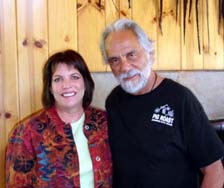
Tommy Chong was here yesterday. Here's a picture of him and me.
Gotta go now. More later.
This is an open thraad.
(9 comments) Permalink :: Comments
Posted on Sun Jun 10, 2007 at 12:26:55 PM EST
Tags: (all tags)
Joe Lieberman stakes out a position held only by Dick Cheney:
"I think we've got to be prepared to take aggressive military action against the Iranians to stop them from killing Americans in Iraq," Lieberman said. "And to me, that would include a strike over the border into Iran, where we have good evidence that they have a base at which they are training these people coming back into Iraq to kill our soldiers."
(Emphasis supplied.) If our soldiers were not in Iraq, they would not be subject to these attacks Lieberman. As I have said many times, the way to stop war with Iran is to end the Debacle in Iraq.
On a related note, noted "extremist" hunter Joe Klein discovers that there is no such thing as a precipitous withdrawal:
(90 comments, 721 words in story) There's More :: Permalink :: Comments
| << Previous 12 | Next 12 >> |