
Football on NBC tonight cut into Keith Olbermann's debut of Countdown on NBC in many parts of the country. In Denver, the network joined the show in progress at 9:30 pm, after the game.
I did get to see the "Worst Person of the World" segment, which was very good. If you missed it, Crooks and Liars has the video. From the transcript:
Limbaugh: “…..Democrats want to get us out of Iraq, but they can’t wait to get us into Darfur.” He continued: “There are two reasons. What color is the skin of the people in Darfur? It’s black. And who do the Democrats really need to keep voting for them? If they lose a significant percentage of this voting bloc, they’re in trouble.” A caller responded, “The black population,” to which Limbaugh said, “Right.”
(21 comments) Permalink :: Comments
Posted on Sun Aug 26, 2007 at 09:51:22 PM EST
Tags: (all tags)
Robert Sillen, court-appointed health-care receiver for California's plagued prisons has been making waves and progress.
So far $1.3 billion has been spent on improving health care.
He has the power to hire, fire, raise salaries, build facilities, waive laws, tap the state treasury and have jailed any bureaucrat who tries to thwart him.....
....“When people ask me how long and how much,” he said, “I have a stock answer: Long. Much.”
Not previously familiar with the criminal justice system, it sounds like Sillen has gotten a crash course.
More...
(7 comments, 356 words in story) There's More :: Permalink :: Comments
Posted on Sun Aug 26, 2007 at 04:00:09 PM EST
Tags: (all tags)
Matt Yglesias has a great post on how historically ignorant Broderism and its drive for a compromise, issueless pragmatism is. As Yglesais shows, Whiggery led to to the rise of an ideological partisan Third Party - the Republican Party of Abraham Lincoln:
I feel like it's worth mentioning here how little time third party enthusiasts ever seem to spend thinking about the rise of the Republican Party -- the only actual precedent for anything of the sort. They often seem to talk as if Abraham Lincoln was just some kind of somewhat disaffected dude sitting around somewhere with this really insightful speech about a how divided against itself, threw his hat in the ring, and -- bam! -- tired old Whig and Democrat ideologies are shunted aside in favor of a bold new era of pragmatism and bloody civil war. One can't do justice to the actual origins of the Republican Party in a blog post, but suffice it to say that it didn't work like that. The history of meaningful third party anti-slavery politics goes back to the abolitionists' Liberty Party in 1840. They later moderated their agenda somewhat, added the support of many breakaway anti-slavery Democrats, and became the Free Soil Party starting in 1848. This party had some very substantial adherents, but still didn't do very well. Then, as the national debate over slavery grew ever-more-intense, breakaway anti-slavery Whigs joined the movement that was now further reconfigured as the Republican Party. This new party did well enough to become a "second party," polling 33 percent while the Whigs got just 21.5 percent.
Matt has written a great concise post that does not, obviously, delve into the complete history of the rise of the Republican Party and the demise of the Whig Party, but I want to explore how Broderism was at the heart of the demise of the Whig Party. To wit, Broder has it backwards - his approach killed a dominant political party and led to an NON-Unity, partisan third party. I'll explore this history on the flip.
(27 comments, 977 words in story) There's More :: Permalink :: Comments
Posted on Sun Aug 26, 2007 at 10:19:25 AM EST
Tags: Geoffrey Fieger (all tags)
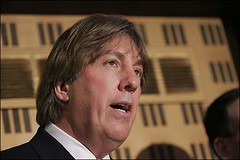
Detroit lawyer Geoffrey Fieger was indicted on Friday, in large part for allegedly conspiring to make illegal campaign contributions to John Edwards.
Geoffrey Fieger, the Southfield lawyer known for winning multimillion-dollar civil judgments and antagonizing judges, has been indicted by a federal grand jury on criminal charges of conspiracy, obstruction of justice, making illegal campaign contributions and causing false statements.
The indictment charges Fieger and a law partner, Vernon (Ven) Johnson, of conspiring to make about $127,000 in illegal contributions to Democratic presidential candidate John Edwards' 2004 campaign.
Famed lawyer Gerry Spence will defend Fieger:
More...
(5 comments, 558 words in story) There's More :: Permalink :: Comments
Posted on Sun Aug 26, 2007 at 09:39:38 AM EST
Tags: Osama bin Laden (all tags)
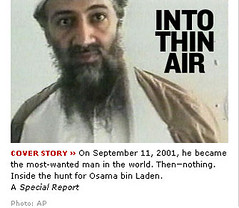
Newsweek's Evan Thomas writes a 15 page online article on why we haven't found Osama bin Laden. A few snippets:
Rather than send the snake eaters to poke around mountain caves and mud-walled compounds, the U.S. military wanted to fight on a grander stage, where it could show off its mobility and firepower. To the civilian bosses at the Pentagon and the eager-to-please top brass, Iraq was a much better target.
By invading Iraq, the United States would give the Islamists—and the wider world—an unforgettable lesson in American power. Former House Speaker Newt Gingrich was on Rumsfeld's Defense Policy Board and, at the time, a close confidant of the SecDef. In November 2001, Gingrich told a NEWSWEEK reporter, "There's a feeling we've got to do something that counts—and bombing caves is not something that counts."
Others say intelligence dried up long ago and the U.S. is just searching for a needle in a haystack, and the chance of success is "zero." Yet, without any intelligence on the whereabouts of Osama or what he's up to, experts quoted in the article maintain:
More...
(30 comments, 371 words in story) There's More :: Permalink :: Comments
Posted on Sun Aug 26, 2007 at 08:01:00 AM EST
Tags: Michael Chertoff (all tags)


U.S. News & World Report writes:
The buzz among top Bushies is that beleaguered Attorney General Alberto Gonzales finally plans to depart and will be replaced by Homeland Security Secretary Michael Chertoff. Why Chertoff? Officials say he's got fans on Capitol Hill, is untouched by the Justice prosecutor scandal, and has more experience than Gonzales did, having served as a federal judge and assistant attorney general.
[Hat tip: Think Progress.]
Chertoff was a federal judge and U.S. Attorney before becoming Homeland Security Secretary. In 2005, the ACLU issued this report on Chertoff and his civil liberties record, and it wasn't pretty. More from a coalition of civil liberties organizations is here.
Guess who was the sole vote against Chertoff's confirmation? Hillary Clinton.
(11 comments) Permalink :: Comments
Posted on Sun Aug 26, 2007 at 07:53:00 AM EST
Tags: NSA surveillance, warrantless wiretapping (all tags)

The New York Times today reports that the Albany terror trial of Yassin M. Aref may have the best chance of challenging the NSA warrantless wiretapping program.
TalkLeft has been writing about Mr. Aref's case since its inception in 2004 (see here) and about its NSA wiretapping connection since Aref's lawyer, Terry Kindlon, filed his first challenge to the program. Aref's case was the Ashcroft-initiated prosecution of the pizza man and the Iman.
From Terry's initial motion:
"The government engaged in illegal electronic surveillance of thousands of U.S. persons, including Yassin Aref, then instigated a sting operation to attempt to entrap Mr. Aref into supporting a nonexistent terrorist plot, then dared to claim that the illegal NSA operation was justified because it was the only way to catch Mr. Aref," Kindlon's motion said.
The Judge denied the motion in a secret ruling. Terry then went to the Second Circuit Court of Appeals asking it to compel the District Court to direct the government to come clean about the role warrantless wiretaps played in its case. He got no relief.
The Government used the "Doogie Howser" of terrorism experts at trial and Aref and his codefendant were convicted. Even though Aref's sentencing guidelines were 30 years to life, the Judge sentenced him to 15 years. Even the Judge didn't believe Aref was motivated by a desire to help terrorists.
More...
(1 comment, 469 words in story) There's More :: Permalink :: Comments
Posted on Sat Aug 25, 2007 at 10:14:49 PM EST
Tags: (all tags)
Brian Baird opposed the war and the Surge. Michael O'Hanlon supported the war and the Surge. Michael O'Hanlon is dishonest. Brian Baird is wrong. Here is Baird's argument:
He ignores the fact that political solutions are nonexistent in Iraq. He has no real information nor real answers. He says six more months. What he expects to happen in six months is not clear. In short, Baird has no actual argument. But give Baird his due, he is not lying when he says he was a war and Surge critic. Michael O'Hanlon IS lying when he says he was an Iraq war and Surge critic. One argument merits respect. It is not the one made by the dishonest Michael O'Hanlon.
(10 comments) Permalink :: Comments
No man who writes this could be:
Dive into a conversation about America in the Arab world today, or even in Europe and Africa, and it won’t take 30 seconds before the words “Abu Ghraib” and “Guantánamo Bay” are thrown at you. Yes, both are shameful, but Abu Ghraib was a day at the beach compared to what Al Qaeda and its Sunni jihadist supporters have been doing in Iraq, yet none of their acts have become one-punch global insults like Abu Ghraib and Guantánamo.
Is Tom Friedman out of his mind? Is his winning argument that 'yes, the United States is shameful, but Al Qaida is worse?'
This man is considered a leading pundit in our country? The last 6 years can come as no surprise in light of that. Friedman is a disgrace.
(92 comments) Permalink :: Comments
Posted on Sat Aug 25, 2007 at 06:16:36 PM EST
Tags: Barack Obama, 2008 (all tags)
Sen. Barack Obama today named the Republican senators he'd work closely with as President. One of them is uber-conservative Sen. Tom Coburn of Oklahoma, who Obama says "has become a friend of mine."
Senator Coburn, who said that lesbianism is "so rampant in some of the schools...that they'll let only one girl go to the bathroom."
Senator Coburn, who claims he can tell if someone is telling the truth because of his medical training.
Dr. Coburn, who said: "You know, I immediately thought about silicone breast implants and the legal wrangling and the class-action suits off that. And I thought I would just share with you what science says today about silicone breast implants. If you have them, you're healthier than if you don't. That is what the ultimate science shows...In fact, there's no science that shows that silicone breast implants are detrimental and, in fact, they make you healthier."
Senator Coburn, who thought Schindler's List was smut, an "all-time low, with full-frontal nudity, violence and profanity.
More....
(20 comments, 305 words in story) There's More :: Permalink :: Comments
Posted on Sat Aug 25, 2007 at 03:52:34 PM EST
Tags: (all tags)
Michael O'Hanlon defends himself again and elides what to me is the fundamental problem with his recent analysis - his dishonest depiction of himself as an Iraq War and Surge critic. He was a strong supporter of both the war and the Surge. O'Hanlon writes:
How can one gather and assess information about Iraq -- collected on a trip or from any other source? Information from a war zone is difficult to attain and interpretation is open to many views. Unfortunately, much of the blogosphere and other media outlets have emphasized the wrong question, challenging the integrity of anyone who dares to express politically incorrect views about Iraq. Last week, Jonathan Finer criticized [O'Hanlon and Pollack] on this page and he ignored how critical Pollack and I have been of administration policy in the past. . . .
(Emphasis supplied.) That is nonsense. O'Hanlon dishonestly continues to portray himself as a critic of the war and the Surge.
He is lying. That is the fundamental problem with his work in my view. Others have taken apart his analysis. I stand by my position that his willingness to lie about his strong support for the war and the Surge disqualifies his analysis from serious consideration. Others can take apart his analysis. I stand by my view that his fundamental dishonesty make his observations not worthy of consideration.
(21 comments) Permalink :: Comments
I'm up in Vail, about to head out the door for an invigorating hike. It's gorgeous outside.
For those of you inside, here's an open thread.
(18 comments) Permalink :: Comments
| << Previous 12 | Next 12 >> |