Tag: war on drugs
Posted on Tue Apr 19, 2016 at 12:59:03 PM EST
Tags: war on drugs (all tags)


The U.N. holding its first special session on the global war on drugs in 20 years. Cracks are showing, but there's a long way to go.
The countries clashed over the death penalty for drug traffickers. Indonesia is unrepentant.
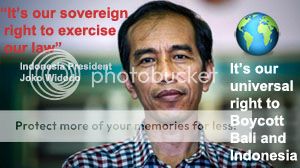
BOYCOTT BALI AND INDONESIA.
The governments of Mexico and Central and South America seem more attuned to the problems:[More...]
(1 comment, 378 words in story) There's More :: Permalink :: Comments
Posted on Thu Nov 05, 2015 at 08:11:00 AM EST
Tags: mexico, marijuana, war on drugs (all tags)

In an 88 page opinion based on principles of human rights, Justice Arturo Zaldívara of the Mexican Supreme Court has paved the way for legal marijuana in Mexico.
The vote by the court’s criminal chamber declared that individuals should have the right to grow and distribute marijuana for their personal use. While the ruling does not strike down current drug laws, it lays the groundwork for a wave of legal actions that could ultimately rewrite them, proponents of legalization say.
Justice Zaldívar writes: "...[T]he state recognizes an individual’s autonomy to engage in recreational activities that do not harm others.
[More...]
(14 comments, 563 words in story) There's More :: Permalink :: Comments
Posted on Tue Jun 09, 2015 at 08:29:22 PM EST
Tags: war on drugs (all tags)
The XXXII International Conference for Drug Control in Cartagena, Colombia, has wrapped up. Tomás Zerón, the head of the Mexico Attorney General's Criminal Investigation Agency, who attended the conference, tells Proceso (use google translate) that there are only two drug cartels and three drug lords left in Mexico: Sinaloa, led by Ismael Zambada-Garcia and Fausto Isidro Meza Flores, and CJNG (Jalisco New Generation)led by Nemesio Oseguera Cervantes. He said Sinaloa deals primarily in cocaine, while CJNG concentrates on meth. He also said Zambada-Garcia doesn't seem too active these days.
Zerón said the Zetas disintegrated, and the Gulf Cartel turned to kidnapping and extortion instead of drugs because it lacks the financing and contacts to obtain drugs. According to Zerón, the Juarez, Tijuana, Beltran Leyva and Knights of Templar cartels have dismantled, due to the death or detention of their leaders (more here), and now are operating as independent cells. [More...]
(3 comments, 377 words in story) There's More :: Permalink :: Comments
Posted on Fri Oct 31, 2014 at 08:30:00 AM EST
Tags: war on drugs (all tags)
This doesn't seem to have picked up as much traction in the U.S. as it has elsewhere, and it may not be huge, but it does represent a shift in stance on the U.S. global war on drugs.
Robert Brownfield, Assistant Secretary, Bureau of International Narcotics and Law Enforcement Affairs, speaking at a foreign press conference in New York on October 9, while discussing the third of the four pillars of global drug policy, said (Full text here):
Things have changed since 1961. We must have enough flexibility to allow us to incorporate those changes into our policies … to tolerate different national drug policies, to accept the fact that some countries will have very strict drug approaches; other countries will legalize entire categories of drugs.
[More...]
(1 comment, 520 words in story) There's More :: Permalink :: Comments
Posted on Sat May 10, 2014 at 01:29:09 PM EST
Tags: war on drugs (all tags)
Via Sentencing Law and Policy: Check out this new law review article by Law Professor Shima Baradaran. It debunks the link between drug crimes and violence.
[This article] demonstrates that a connection between drugs and violence is not supported by historical arrest data, current research, or independent empirical evidence. That there is little evidence to support the assumption that drugs cause violence is an important insight, because the assumed causal link between drugs and violence forms the foundation of a significant amount of case law, statutes, and commentary.
In particular, the presumed connection between drugs and violence has reduced constitutional protections, misled government resources, and resulted in the unnecessary incarceration of a large proportion of non-violent Americans. In short, if drugs do not cause violence — and the empirical evidence discussed in this Article suggests they do not — then America needs to rethink its entire approach to drug policy.
[More...]
(14 comments, 275 words in story) There's More :: Permalink :: Comments
Posted on Wed May 07, 2014 at 08:04:00 AM EST
Tags: prisons, war on drugs (all tags)

Human Rights Watch has a new report, A Nation Behind Bars, with facts on the current state of our prison nation and recommendations to reduce our over-reliance on incarceration.
Some facts:[More...]
(8 comments, 1493 words in story) There's More :: Permalink :: Comments
Posted on Wed Oct 02, 2013 at 11:20:33 AM EST
Tags: war on drugs (all tags)
As many have been saying for years, the Global war on drugs has been an epic failure:
The International Centre for Science in Drug Policy said its report suggested the war on drugs had failed. The report, published in the British Medical Journal Open, looked at data from seven international government-funded drug surveillance systems.
(52 comments) Permalink :: Comments
Posted on Fri Dec 07, 2012 at 08:45:00 AM EST
Tags: war on drugs (all tags)
Richard Branson, founder of Virgin Group and member of the Global Drug Commision, has an op-ed at CNN on the failure of the war on drugs.
Here we are, four decades after Richard Nixon declared the war on drugs in 1971 and $1 trillion spent since then. What do we have to show for it?
The U.S. has the largest prison population in the world, with about 2.3 million behind bars. More than half a million of those people are incarcerated for a drug law violation. What a waste of young lives.
[More...]
(37 comments, 894 words in story) There's More :: Permalink :: Comments
Posted on Sat Oct 13, 2012 at 09:05:00 AM EST
Tags: war on drugs, Amendment 64, DEA (all tags)
Via the New York Times: U.S. Rethinks a Drug War After Deaths in Honduras
All joint operations in Honduras are now suspended. Senator Patrick J. Leahy of Vermont, expressing the concerns of several Democrats in Congress, is holding up tens of millions of dollars in security assistance, not just because of the planes, but also over suspected human rights abuses by the Honduran police and three shootings in which commandos with the United States Drug Enforcement Administration effectively led raids when they were only supposed to act as advisers.
DEA's FAST program began under George W Bush. (Obama has extended it.) FAST stands for Foreign-deployed Advisory Support Team. In plain English, squads of commandos. It operates in Haiti, Honduras, the Dominican Republic, Guatemala and Belize. Here's a powerpoint about it.
The Administration's total Drug War budget for 2013 is $25 billion. [More.]
(11 comments, 1348 words in story) There's More :: Permalink :: Comments
Posted on Thu Sep 06, 2012 at 04:29:29 PM EST
Tags: informants, War on Drugs (all tags)
The New Yorker has an extensive article, The Throwaways , on the misuse of informants.
Informants are the foot soldiers in the government’s war on drugs. By some estimates, up to eighty per cent of all drug cases in America involve them, often in active roles like Hoffman’s. For police departments facing budget woes, untrained C.I.s provide an inexpensive way to outsource the work of undercover officers. “The system makes it cheap and easy to use informants, as opposed to other, less risky but more cumbersome approaches,” says Alexandra Natapoff, a professor at Loyola Law School in Los Angeles and a leading expert on informants. “There are fewer procedures in place and fewer institutional checks on their use.” Often, deploying informants involves no paperwork and no institutional oversight, let alone lawyers, judges, or public scrutiny; their use is necessarily shrouded in secrecy.
[More....]
(6 comments, 1170 words in story) There's More :: Permalink :: Comments
Posted on Wed Aug 29, 2012 at 11:58:03 PM EST
Tags: War on Drugs, Guatemala (all tags)
The militarization of the war on drugs is officially underway.
A team of 200 U.S. Marines began patrolling Guatemala's western coast this week in an unprecedented operation to beat drug traffickers in the Central America region, a U.S. military spokesman said Wednesday.
The Marines are deployed as part of Operation Martillo, a broader effort started last Jan. 15 to stop drug trafficking along the Central American coast. Focused exclusively on drug dealers in airplanes or boats, the U.S.-led operation involves troops or law enforcement agents from Belize, Britain, Canada, Colombia, Costa Rica, El Salvador, France, Guatemala, Honduras, the Netherlands, Nicaragua, Panama and Spain.
Wired has more here.
(10 comments) Permalink :: Comments
Posted on Mon Jul 02, 2012 at 12:19:30 PM EST
Tags: Obama, War on Drugs (all tags)
Marc Ambinder's new article suggesting Obama will shift his position on the War on Drugs if he gets re-elected doesn't offer much.
Since the United Ststes isn't about to legalize or regulate the illegal narcotics markets, the best thing a president can do may be what Obama winds up doing if he gets re-elected: using the bully pulpit to draw attention to the issue. But he won't do so before November.
The article is more a review of the documentary The House I Live In, which I wrote about in January here than it is about Obama.
I have no expectations Obama will ease up on the War on Drugs. But since we know that Republicans will keep escalating it, as they will our over-reliance on incarceration, the choice in November on this issue is clear: Obama.
(67 comments) Permalink :: Comments
| Next 12 >> |