home

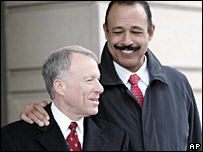
Ted Wells Discusses Scooter Libby's Conviction

I was checking White Collar Crime Blog to get Professor Ellen Podgor's take on the Don Siegelman decision, but learned she's at the ABA White Collar Crime conference in San Francisco. One panel she attended was about the white collar trials of 2007. Ted Wells, Scooter Libby's lawyer, was one of the panelists. She writes:

The eight male speakers covered the cases of Michael Reyes (Brocade), Joseph Nacchio (Qwest), Scooter Libby and the KPMG defendants. One recurring theme was what I call the "the context of the case."

For example, in discussing the Scooter Libby case, Theodore V. Wells, Jr. noted how the Scooter Libby case could be seen as a proxy for how people felt about President Bush and the war. It was a "he said-she said" case on a 20 second phone call - but the timing of the trial was important.

[More...]

Ellen notes that Sol Wisenberg, a former AUSA and Deputy Independent counsel in the Whitewater investigation, now a white collar criminal defense lawyer and (a self-described politically conservative-libertarian) was also writing about the conference at his blog, Letter of Apology. So I checked there for Sol's comments about Ted Wells:

Ted Wells, who represented Scooter Libby, was, true to form, an outstanding panelist. Wells stressed that Libby faced a choice, when deciding whether to testify before the grand jury, between increasing his criminal exposure and losing his job. This is a choice sometimes faced by politicians and public servants who are witnesses, subjects, and targets. It is a choice also faced by corporate executives who are asked to participate in internal investigations or testify at the SEC. The ultimate question that all of these people should ask themselves, at every stage of the game, is: “What do I prefer–to lose my job or my liberty?”

Wells reminded the audience that even the sharpest clients and attorneys often cannot comprehend the full scope of a criminal investigation. Thus there is no way to be prepared for every question. Libby, before he hired Wells, testified in front of the grand jury, apparently not realizing that Patrick Fitzgerald’s mandate was much broader than the question of who leaked Valerie Plame’s name to Robert D. Novak.

Sol goes on to note that the white collar panel generally agreed letting your client talk isn't a good idea. Most of them blamed their client's prior lawyers:

There was general agreement among the attorneys on the panel that the talking had been a major mistake. The decisions to talk had been made for the most part by previous counsel on the cases at issue.

I think those of us on the defense side who aren't former AUSA's have known this from the get-go. As I always say, the jails are filled with people who thought if they could only tell their side of the story, the cops and prosecutors would see it their way. The Fifth Amendment privilege against self-incrimination is there for a reason. Use it.

If white collar crime is of interest to you, White Collar Crime Blog and Letter of Apology are two you will want to bookmark.

< MN Supreme Court Denies Franken Request For Certification Of Election | Late Night Open Thread >
  • Premium Ads

  • Blog Ads

  • Contribute To TalkLeft

    donate to TalkLeft


  • Display: Sort:
    Your mind seems to be clouded here (1.00 / 1) (#7)
    by Dark Avenger on Sun Mar 08, 2009 at 09:30:02 AM EST
    no one has established that outing Plame was a crime since no one has been indicted for it

    Sometimes no indictment doesn't mean a crime hasn't been committed, but that the prosecutor, (Fitzgerald in this case) doesn't believe he can prove a crime was committed in open court.

    Did you forget what Fitzpatrick said in his press conference?:

    Before I talk about those charges and what the indictment alleges, I'd like to put the investigation into a little context. Valerie Wilson was a CIA officer. In July 2003, the fact that Valerie Wilson was a CIA officer was classified. Not only was it classified, but it was not widely known outside the intelligence community. Valerie Wilson's friends, neighbors, college classmates had no idea she had another life. The fact that she was a CIA officer was not well-known, for her protection or for the benefit of all us. It's important that a CIA officer's identity be protected, that it be protected not just for the officer, but for the nation's security. Valerie Wilson's cover was blown in July 2003. The first sign of that cover being blown was when Mr. Novak published a column on July 14th, 2003. But Mr. Novak was not the first reporter to be told that Wilson's wife, Valerie Wilson, Ambassador Wilson's wife Valerie, worked at the CIA. Several other reporters were told. In fact, Mr. Libby was the first official known to have told a reporter when he talked to Judith Miller in June of 2003 about Valerie Wilson.

    Diogenes, with the memory difficulties you've demonstrated lately, it would behoove you to see a neurologist or perhaps a specialist in psychological matters to help you with your obvious problem in this area.

    Interesting (none / 0) (#1)
    by Big Tent Democrat on Fri Mar 06, 2009 at 05:20:06 PM EST
    I always heard you on this point and I always analogized it in the civil context to trying to get your client to say as little as possible in a deposition.

    If you needed them to say something, you could do it in an affidavit or, if there were a trial (these are few and far between in commercial litigation), on direct examination.

    So, do your clients heed your advice? (none / 0) (#2)
    by oculus on Fri Mar 06, 2009 at 09:20:04 PM EST


    [ Parent ]
    Since Libby had several years experience (none / 0) (#3)
    by imhotep on Fri Mar 06, 2009 at 09:37:49 PM EST
    as a practicing attorney, why didn't he know this?

    Libby probably felt (none / 0) (#5)
    by Amiss on Fri Mar 06, 2009 at 11:09:48 PM EST
    he could "outsmart" the prosecution.

    [ Parent ]
    But.... (none / 0) (#4)
    by NYShooter on Fri Mar 06, 2009 at 09:54:00 PM EST
    what's best for the client is not necessarily what's best for truth, justice, and the American way.

    fifth amendment??? (none / 0) (#6)
    by diogenes on Sat Mar 07, 2009 at 08:07:19 PM EST
    If there was no crime (no one has established that outing Plame was a crime since no one has been indicted for it, whatever the theories of people here who did not sit on the Fitz grand jury) then how was Libby supposed to plead the fifth?  Exactly how would he incriminate himself if no crime in fact happened?