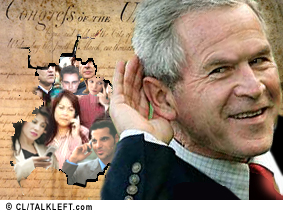
FISA Court Asked FBI About Illegal Wiretapping

Ryan Singal reports newly declassified documents show that the FISA Court had concerns the FBI was wiretapping innocent Americans:
Does the FBI track cellphone users' physical movements without a warrant? Does the Bureau store recordings of innocent Americans caught up in wiretaps in a searchable database? Does the FBI's wiretap equipment store information like voicemail passwords and bank account numbers without legal authorization to do so?
That's what the nation's Foreign Intelligence Surveillance Court wanted to know, in a series of secret inquiries in 2005 and 2006 into the bureau's counterterrorism electronic surveillance efforts, revealed for the first time in newly declassified documents.
A review of the declassified documents shows: [More...]
Among other things, the declassified documents reveal that lawyers in the FBI's Office of General Counsel and the Justice Department's Office of Intelligence Policy Review queried FBI technology officials in late July 2006 about cellphone tracking. The attorneys asked whether the FBI was obtaining and storing real-time cellphone-location data from carriers under a "pen register" court order that's normally limited to records of who a person called or was called by.
The internal inquiry seems to have preceded, and was likely prompted by, a secret court hearing on the matter days later. Kevin Bankston, a lawyer with Electronic Frontier Foundation, says the documents suggest that the nation's spy court shares the reluctance of federal criminal courts to turn everyday cellphones into tracking devices, in the absence of evidence that the target has done something wrong.
What about those post-call dialed numbers?
Separately, the secret court questioned if the FBI was using pen register orders to collect digits dialed after a call is made, potentially including voicemail passwords and account numbers entered into bank-by-phone applications.
Using a pen register order, the FBI can force a phone company to turn over records of who a person calls, or is called by, simply by asserting the information would be relevant to an investigation. But existing case law holds that those so-called "post-cut-through dialed digits" count as the content of a communication, and thus to collect that information, the FBI would need to get a full-blown wiretapping warrant based on probable cause.
What did the FBI do with the data it collected?
The government is supposed to "minimize" -- that is anonymize or destroy -- information gathered on Americans who aren't the targets of a wiretap, unless that information is crucial to an investigation.
There are no answers here, only more questions.
| < Rezko Defends Obama in Letter to Judge | How To Read A Poll: Part X > |