home

Monday Open Thread

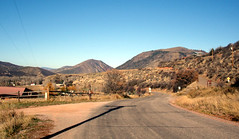
I'm not quite ready to drive down the mountain yet. Until I get home tonight, here's an open thread for you. And a picture of the peacock who lives in the house I'm staying at.

I see there's a new attack on the Eagles' new album for promoting fear about global warming and not attacking islamo-fascism.

There's a Wal-Mart in Glenwood Springs I have to pass on the way to I-70. I think I'll stop in and buy it for the ride home and see for myself.

< Edwards' Doubletalk On Drivers Licenses For Undocumented Aliens | Atrios Is Wrong: What Democrats Need To Do >
  • Premium Ads

  • Blog Ads

  • Contribute To TalkLeft

    donate to TalkLeft


  • Display: Sort:
    Falafel Eaters (5.00 / 1) (#1)
    by squeaky on Mon Nov 05, 2007 at 12:32:19 PM EST
    The FBI is so desperate to help this admin's cause to war with Iran that is has resorted to  tracking surges in falafel consumtion in SF in order to catch Iranian terrorists.   Heckuva job.  

    Like Hansel and Gretel hoping to follow their bread crumbs out of the forest, the FBI sifted through customer data collected by San Francisco-area grocery stores in 2005 and 2006, hoping that sales records of Middle Eastern food would lead to Iranian terrorists.

    The idea was that a spike in, say, falafel sales, combined with other data, would lead to Iranian secret agents. A similar project was aimed at Sunni Arabs in the Washington, D.C., area.

    Jeff Stein via War & Piece

    Zappa (1.00 / 0) (#3)
    by Edger on Mon Nov 05, 2007 at 01:03:03 PM EST
    It's not getting any smarter out there...


    [ Parent ]
    Sounds like our FBI.... (none / 0) (#4)
    by kdog on Mon Nov 05, 2007 at 01:24:45 PM EST
    Am I good American if I put bacon on my falafels?

    (Seriously, its pretty good:)

    [ Parent ]

    Lawfare (5.00 / 2) (#2)
    by squeaky on Mon Nov 05, 2007 at 12:50:35 PM EST
    Opposing "judicial activism" is one of the rallying cries of the American right.

    [snip]

    Not until the Bush administration, however, was this political code word integrated into the National Security Doctrine of the United States. Scott Horton of Harper's, writing on "Bush's War on the Rule of Law" describes how the attack on judicial activism entered national security doctrine through the concept of "lawfare":

    [snip]

    Unlike Bush, Musharraf at least had the decency to announce to the whole world that he was placing the constitution "in abeyance" and arrogating all power to his sole person. The Bush administration prefers to promulgate shadowy memoranda, signing statements, and Humpty-Dumpty like amendments to the meaning of common words. Since the courts are instruments of terrorists (and can even be used to demoralize the security forces!) counter-terrorism logically requires the abolition of the rule of law.

    Barnett Rubin

    Wilkes Guilty On All Counts (1.00 / 0) (#7)
    by squeaky on Mon Nov 05, 2007 at 04:02:17 PM EST
    A U.S. District Court jury has found Brent Wilkes, who was charged with bribing disgraced former Rep. Randy "Duke" Cunningham, guilty on all 13 counts in his corruption trial. TPM's Paul Kiel notes that today's verdict is from just the first of the two corruption trials Wilkes faces. The second involves former CIA executive director Dusty Foggo.

    think progress

    Pakistan is US (1.00 / 0) (#9)
    by squeaky on Wed Nov 07, 2007 at 04:32:51 PM EST
    We are the model these days for lessons in how to maintain authoritarian rule.

    Do whatever it takes to fan the radical extremists flames while being careful not to extinguish the leadership (where is OBL). Meanwhile do whatever it takes to marganalize the intellectuals.

    Pakistan is doing nothing to those it needs for justifying authoritarian rule while jailing those who want to protece the constitution.

    While the Pakistani military is bothering innocent human rights activists and attorneys who want to defend the country's constitution, it is ignoring Muslim radicals' advances in the north of the country, according to Zee News:

    ' Pro-Taliban militants have strengthened their hold on the Swat valley in northwestern Pakistan by seizing several key towns after outnumbered security forces laid down their arms and fled their posts.

    Juan Cole


    Too Bad.... (none / 0) (#5)
    by kdog on Mon Nov 05, 2007 at 01:50:11 PM EST
    One of the very few candidates worth voting for has dropped out of the race.

    Imagine if he won in Carolina...it could have started something special.  Kubby once again has my full support.

    30% (none / 0) (#6)
    by jondee on Mon Nov 05, 2007 at 03:43:33 PM EST
    I was wondering the other day if 30% of the people who listened to the Orson Welles War of the Worlds broadcast were the ones who: evacuated (in both senses); began rifling Revelations for Martian refernences; committed suicide; ran around like chickenhawks with their heads cut off etc.

    30% sounds about right for some reason.


    One factor to consider (5.00 / 1) (#8)
    by Dark Avenger on Mon Nov 05, 2007 at 09:33:41 PM EST
    is that many folks didn't catch the broadcast from the start:

    Many people missed or ignored the opening credits of the program, and in the atmosphere of growing tension and anxiety in the days leading up to World War II, took it to be a news broadcast. Contemporary newspapers reported that panic ensued, with people fleeing the area, and others thinking they could smell the poison gas or could see the flashes of the lightning in the distance.

    Professor Richard J. Hand cites studies by unnamed historians who "calculate[d] that some six million heard the Columbia Broadcasting System broadcast; 1.7 million believed it to be true, and 1.2 million were 'genuinely frightened'". (Hand, 7) While Welles and company were heard by a comparatively small audience (in the same time period, rival station NBC's audience was an estimated 30 million), the uproar that followed was anything but minute: within a month, there were about 12,500 newspaper articles about the broadcast or its impact (Hand, 7), while Adolf Hitler cited the panic, as Hand writes, as "evidence of the decadence and corrupt condition of democracy." (Hand, 7)

    Later studies suggested this "panic" was far less widespread than newspaper accounts suggested. However, it remains clear that many people were caught up, to one degree or another, in the confusion that followed.

    Robert Bartholomew and Hilary Evans suggest in Panic Attacks that hundreds of thousands of people were frightened in some way, but note that evidence of people taking action based on this fear is "scant" and "anecdotal." Indeed, contemporary news articles indicate that police were swamped with hundreds of calls in numerous locations, but stories of people doing anything more than calling up the authorities typically involve groups of ones or tens and were often reported by people who were panicking, themselves.

    Later studies also indicated that many listeners missed the repeated notices that the broadcast was entirely fictional, partly because the Mercury Theatre (an unsponsored "cultural" program with a relatively small audience) ran opposite the popular Chase and Sanborn Hour over the Red Network of NBC, hosted by Don Ameche and featuring comic ventriloquist Edgar Bergen and singer Nelson Eddy, at the time three of the most popular figures in broadcasting. About 15 minutes into the Chase and Sanborn program the first comic sketch ended and a musical number began, and many listeners presumably began tuning around the dial at that point. According to the American Experience program "The Battle Over Citizen Kane", Welles knew the schedule of the Chase & Sanborn show, and scheduled the first report from Grover's Mill at the 12 minute mark to heighten the audience's confusion. As a result, some listeners happened upon the CBS broadcast at the exact point the Martians emerge from their spacecraft.

    Many of these listeners were apparently confused. In fairness, it must be noted that the confusion cannot be credited entirely to naïveté. Though many of the actors' voices should have been recognisable from appearances on other radio shows, nothing like The War of the Worlds broadcast had ever been attempted in the United States, so listeners were accustomed to accepting newsflashes as reliable.

    While there were repeated statements concerning the fictional nature of the program, no such statement was broadcast between the 12 minute and 40 minute marks. In fact, the warning at the 40 minute mark is the only one that occurs after the actors start speaking in character, and before Welles breaks character at the end. This structure is roughly similar to earlier Mercury Theatre broadcasts: due to the lack of sponsorship (which often included a commercial message at the 30-minute mark during an hour-long show), Welles and company were able to schedule breaks more or less at will, depending on the pacing of a given narrative.

    While the War of the Worlds broadcast was in progress, some residents in northeastern cities went outside to ask neighbours what was happening (many homes still did not have telephones at this time). As the story was repeated by word of mouth, rumours began to spread, and these rumours caused some panic.

    Contemporary accounts spawned urban legends, many of which persist and have come to be accepted through repetition as fact: Several people reportedly rushed to the "scene" of the events in New Jersey to see if they could catch a glimpse of the unfolding events, including a few astronomers from Princeton University who went looking for the "meteorite" that had supposedly fallen near their school. Some people, who had brought firearms, reportedly mistook a farmer's water tower for an alien spaceship and shot at it.


    [ Parent ]