Making Sense in the Immigration Debate
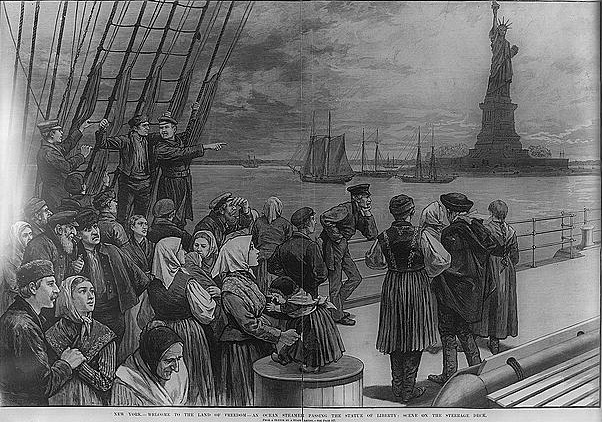
The Washington Post has an article today comparing the immigration debate today with that of a century ago. It nicely puts the lie to the claim that in the old days, people came to to the U.S., particularly Ellis Island legally, with permission. There was no permission necessary until 1918.
Until 1918, the United States did not require passports; the term "illegal immigrant" had no meaning. New arrivals were required only to prove their identity and find a relative or friend who could vouch for them.
Customs agents kept an eye out for lunatics and the infirm (and after 1905, for anarchists). Ninety-eight percent of the immigrants who arrived at Ellis Island were admitted to the United States, and 78 percent spent less than eight hours on the island. (The Mexico-United States border then was unguarded and freely crossed in either direction.) "
Another excellent read is this letter to the editor in the Aspen Daily News. Jordan E. Mollersten reminds us of the simple laws of supply and demand when it comes to the labor force. His argument makes a lot of sense to me.
Virtually everyone agrees on one fact: The undocumented workers come here from Mexico and Central America because they hear through the grapevine that they can get jobs that pay much better than in their home countries. So they come here because there is a demand for labor.
In terms of supply and demand in the U.S. economy, as long as there are jobs to fill for people from south of the border, there will be people coming to fill them. If they cannot come legally, which is currently the case for most of them, they will come across the border any way they can. If at some point in the future there should be no more jobs to fill by people from south of the border, those people will stop coming. In other words, the forces of supply and demand of labor, if allowed to interact freely, will self-regulate the influx of immigration from countries such as Mexico.
Mollersten says our immigration laws are to blame:
It is the failure of the U.S. federal government to allow sufficient numbers of people to come into the country legally which is the real source of the 12 million undocumented immigrant problem. U.S. immigration law is completely out of touch with the reality of supply and demand of unskilled labor in the American economy. The restrictions of the federal immigration policy is as much out of touch with labor demand in the U.S. economy as the federal prohibition law of the 1920s and 30s was out of touch with the deep sociocultural significance in American society of the consumption of beverages containing alcohol.
His recommendation, with which I also agree:
Since people will come here, documented or not, as long as they know they will find employment, allow a much greater number of foreign people to join our work force legally. Make it easier and faster for those people to attain citizenship. This way, the problem with "illegal immigration" will be transformed into a return to the great American tradition of supporting a growing economy with workers who come here from other countries and who are willing to work hard for little.
Just as the people of past waves of immigration enriched American culture and strengthened the American economy, most of those people will become an asset to American society and the economy, not a burden -- millions of undocumented immigrants already have.
| < Continuing the Duke Lacrosse Players Discussion | Cop Replicates Search from "The Shield" > |