Posted on Thu Feb 22, 2007 at 02:28:49 PM EST
Tags: Libby Trial (all tags)



Here are the first two notes sent by the jury in the Scooter Libby trial:
Update: Jury's done for the day.(40 comments) Permalink :: Comments
Via How Appealing:
From an opinion that a unanimous three-judge panel of the U.S. Court of Appeals for the Eighth Circuit issued today, "The police could not have removed the drugs that Williams stashed near his genitals without making some 'intimate contact,' and we reject Williams's claim that such contact is per se unreasonable." According to the factual background section of the opinion, "The officer, who was wearing a latex glove, opened Williams's pants, reached inside Williams's underwear, and retrieved a large amount of crack and powder cocaine near Williams's genitals."
(12 comments) Permalink :: Comments
Posted on Thu Feb 22, 2007 at 02:10:43 PM EST
Tags: Jose Padilla (all tags)
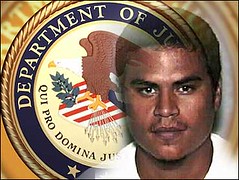
Via Raw Story, A psychiatrist testified today Jose Padilla has Stockholm Syndrome.
A pre-hearing synopsis is at the Miami Herald.
(28 comments) Permalink :: Comments
More than two years ago, the Boston police fired a pepper spray projectile into the eye of a college student during the celebration of a Red Sox victory. The student died. The incident convinced some police agencies to stop using the pellet gun as a crowd control device. Boston suspended its use of the weapon, and a 2005 commission report faulted the city for buying the pellet guns and for failing to train officers to use them safely.
This week, Boston finally found a responsible use for the pellet guns.
The department's 13 pellet guns, bought before the 2004 Democratic National Convention, will be melted down and recycled into sewer caps.
(2 comments) Permalink :: Comments
Bad news for the National Guard members who put their lives on hold to fight the president's war in Iraq: 14,000 of them are going back, joining the troop escalation.
National Guard officials told state commanders in Arkansas, Indiana, Oklahoma and Ohio last month that while a final decision had not been made, units from their states that had done previous tours in Iraq and Afghanistan could be designated to return to Iraq next year between January and June, the officials said.The unit from Oklahoma, a combat brigade with one battalion currently in Afghanistan, had not been scheduled to go back to Iraq until 2010, and brigades from the other three states not until 2009. Each brigade has about 3,500 soldiers.
Whether they'll be properly equipped is an open question.
Capt. Christopher Heathscott, a spokesman for the Arkansas National Guard, said the state’s 39th Brigade Combat Team was 600 rifles short for its 3,500 soldiers and also lacked its full arsenal of mortars and howitzers.
(27 comments) Permalink :: Comments
Anti-abortion activists had hoped to use South Dakota's tough new abortion prohibition as a test case -- testing the positions of the Supreme Court's newest members, Justice Alito and Chief Justice Roberts. The plan ran into a snag when South Dakota voters rejected the law.
Proponents of the strategy hoped that the state legislature would ignore the will of the voters and pass another ban, this one containing exceptions for rape, incest and life-threatening conditions. The Senate Affairs Commmittee today rejected the new bill by a vote of 8-1. The Committee deserves a shout out for declining to waste time and money by advancing unconstitutional legislation.
(1 comment) Permalink :: Comments
The war against drugs has often been a war against the truth. A lawsuit filed today challenges the federal government's unyielding claim that marijuana has no efficacious medical use.
The lawsuit, filed today in federal court in Oakland, comes a week after the release of a controlled, clinical University of California, San Francisco study showing HIV patients who smoked marijuana found relief from chronic foot pain.
"We are asking the courts to weigh in on the science ... and force the government to stop making false statements about medical cannabis," said Steph Sherer, executive director of Americans for Safe Access.
The ASA argues that the administration is ignoring science, a charge that has become depressingly familiar. While the Bush years have been particularly hostile to science, no administration has been willing to authorize serious research into the medical benefits of marijuana.
(28 comments, 323 words in story) There's More :: Permalink :: Comments
Posted on Wed Feb 21, 2007 at 01:00:57 PM EST
Tags: detainee, Guantanamo (all tags)
The National Association of Criminal Defense Lawyers today issued this press release on the D.C. Circuit Court of Appeals decision denying habeas rights to Guantanamo detainees:
The National Association of Criminal Defense Lawyers is extremely disappointed in the decision in which a divided panel on the D.C. Circuit Court of Appeals ruled that none of the prisoners at Guantanamo Naval Base have any right to challenge their indefinite imprisonment in federal court. The court ruled, in effect, that the United States can imprison people virtually forever without judicial review.
These prisoners were captured by the United States, are confined in prisons built by the United States, are guarded by members of the United States Armed Forces, are subjected to interrogation by the United States intelligence services, and may be imprisoned for the rest of their lives, yet they cannot even petition a court for a writ of habeas corpus for determination whether their imprisonment was the result of a mistake.
(5 comments, 431 words in story) There's More :: Permalink :: Comments
I'm off now to San Diego where I'll be speaking Thursday on using the internet for legal research and investigation and on Friday, conducting a workshop on blogging for the National Association of Criminal Defense Lawyers (NACDL).
I'll be checking in periodically, and of course, staying on top of the Scooter Libby jury deliberations.
After the verdict is in, I'm scheduled to do a live chat for the Washington Post
Here's an open thread to discuss other issues, and as always, a big thanks to TChris and Big Tent Democrat for keeping TalkLeft going while I've been on Libby assignment.
(61 comments) Permalink :: Comments
Posted on Wed Feb 21, 2007 at 12:03:35 PM EST
Tags: Libby Trial (all tags)

Marcy (Empty Wheel)was in the media room and courtroom today live-blogging at Firedoglake and watching the jury and lawyers.
I just received this email from DOJ spokesman Randall Samborn:
Mr. Fitzgerald will not be available after a verdict for one-on-one interviews or talk shows. We do anticipate that he will speak to the media after a verdict outside the Courthouse.
My main question which I hope a reporter asks: Is this investigation over? I sure hope the answer is "no."
Due to the length of Scooter's grand jury testimony and the voluminous exhibits introduced, I would not be surprised if this jury doesn't come back before Friday. I'm not going to make a prediction for conviction or acquittal. But, I do think a very fast verdict means acquittal and a very prolonged one means a split (compromise) verdict or a hung jury.(6 comments) Permalink :: Comments
Posted on Wed Feb 21, 2007 at 11:39:04 AM EST
Tags: (all tags)
One of the infamous legal theories that has underpinned the abuse of the Constitution by the Bush Administration has been the Unitary Executive:
What does a "unitary executive mean . . . for Bush:The executive branch shall construe Title X in Division A of the Act, relating to detainees, in a manner consistent with the constitutional authority of the President to supervise the unitary executive branch and as Commander in Chief and consistent with the constitutional limitations on the judicial power, which will assist in achieving the shared objective of the Congress and the President, evidenced in Title X, of protecting the American people from further terrorist attacks.
But in order to distinguish the SCOTUS' Rasul decision in the recent Gitmo habeas case, the Bush Administration has disavowed implicitly the unitary executive theory. Yes, heads will spin.
(8 comments, 1504 words in story) There's More :: Permalink :: Comments
Posted on Wed Feb 21, 2007 at 01:35:51 AM EST
Tags: Libby Trial (all tags)
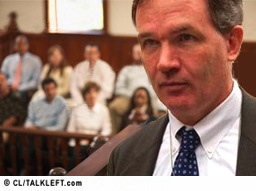
I'm so conflicted.
I believe that the Office of the Vice President, particularly Dick Cheney and Scooter Libby, went all out to attack Joseph Wilson after his July 6th New York Times Op-ed criticizing the intelligence relied on by the Administration to justify its decision to go to war in Iraq.
I believe the evidence at Scooter Libby's trial established that Cheney was livid over Wilson and that he used the C.I.A., the State Department and the Department of Defense to search for dirt on him. Through his inquiries, Cheney learned that Wilson's wife, Valerie Plame Wilson, worked for the CIA in the counter-proliferation division on weapons of mass destruction. He received information that she might have had a role in sending Wilson to Niger to check on intelligence claims that Iraq was acquiring uranium for use in WMD's.
More...
(39 comments, 1403 words in story) There's More :: Permalink :: Comments
| << Previous 12 | Next 12 >> |