Posted on Mon Jul 30, 2007 at 04:43:00 PM EST
Tags: (all tags)


In Pennsylvania, a pregnant inmate is left in her Lackawanna county jail cell alone during labor while guards monitor her with a camera and refuse her assistance.
Despite her pleas for help and screams, she was forced to give birth unattended. After the baby was born, a female jailer reportedly cut the umbilical cord with her fingernails. Only then, were mother and daughter brought to the hospital.
The county has praised the prison staff's actions.
County officials are contending the staff at the prison reacted "fantastically" and told local reporters they believed the prison guards and the nurse on duty were diligent in their care.
County commissioner and chairman of the county prison board A.J. Munchak, Warden Janine Donate and Dr. Edward Zaloga, the county prison's chief medical director, all praised the staff. "As I said yesterday [Monday], medically, medical-wise and security-wise, everything was done properly," Munchak told the Scranton Times-Tribune
The mother has filed a lawsuit alleging violation of her civil rights. The baby is now in foster care.
(14 comments) Permalink :: Comments
Posted on Mon Jul 30, 2007 at 04:04:23 PM EST
Tags: Alberto Gonzales (all tags)
Via Oreo at Daily Kos, Rep. Jay Inslee (D-WA) will introduce a resolution before the House Judiciary Committee tomorrow asking that an inquiry be initiated to determine whether there are grounds to impeach Alberto Gonzales.
Directing the Committee on the Judiciary to investigate whether Alberto R. Gonzales, Attorney General of the United States, should be impeached for high crimes and misdemeanors.
Resolved, That the Committee on the Judiciary shall investigate fully whether sufficient grounds exist for the House of Representatives to impeach Alberto R. Gonzales, Attorney General of the United States, for high crimes and misdemeanors.
Contrary to Big Tent Democrat who favors Gonzales' impeachment, I don't have a position on it. Generally, I'm inclined against impeachment proceedings as an unnecessary usurption of Congressional time and money that could be better spent elsewhere.
Gonzales is a bigger detriment to the Republicans in 2008 if he remains as Attorney General. He will tarnish Bush's legacy permanently and Republican candidates will face a backlash because of him. If he goes early, voters may get over it by then.
More....
(8 comments, 299 words in story) There's More :: Permalink :: Comments
In an interview with Mark Knoller of CBS news that airs today, Vice President Dick Cheney voices support for Alberto Gonzales and says he was truthful with Congress.
In the 13 minute interview, which you can watch here, Cheney also discusses Scooter Libby.
Contrary to Bush who said he accepted the jury's verdict but thought the sentence was excessive, Cheney says Libby's jury got the verdict wrong.
I don't know when the interview was conducted, but I assume it was yesterday or today since Cheney was in the hospital getting his pacemaker battery updated Saturday. I don't have time to watch the interview now, but I wonder if the Knoller asked Cheney if he was the one who sent Gonzales and Card to John Ashcroft's hospital room in March, 2004. A New York Times editorial Sunday said Cheney directed the visit, but no one else seems to have confirmed that.
More....
(3 comments, 320 words in story) There's More :: Permalink :: Comments
Posted on Mon Jul 30, 2007 at 01:42:38 PM EST
Tags: (all tags)
As an "Evil Democrat", wishing us defeat in Iraq, let me further undermine the troops by pointing to posts that demonstrate why Michael O'Hanlon and Ken Pollack have lost all credibility on Iraq:
Greg Sargent and . . . .
Joe Klein. Yep, that Joe Klein.
See also Robert Farley:
(7 comments, 208 words in story) There's More :: Permalink :: Comments
Posted on Mon Jul 30, 2007 at 12:42:20 PM EST
Tags: (all tags)
Blogometer's Conn Carroll writes:
[T]here was a clear opening for Barack Obama to embrace the netroots and tap into their enthusiasm for a more progressive Dem party. . . . Obama could have joined forces with Sen. Russ Feingold (D) to end the war through de-funding and cemented his anti-war credentials.Instead he chose a more measured path on the war (timelines, some residual forces, etc.) and did not pro-actively engage the netroots community. Now, as more and more are noting that his numbers have flatlined, Obama may be changing course.
Using his dictator-meeting exchange with HRC as launching point, Obama has launched a major netroots banner ad buy featuring a 'Judgment Matters' message that touts his pre-Senate opposition of the war and his eagerness to talk to 'our adversaries.'
It has always been my view that Obama's biggest campaign mistake was his failure to differentiate himself on Iraq. It amazed me that not only had John Edwards seemed to have outflanked him on the issue but that Hillary Clinton had neutralized it. More.
(17 comments, 584 words in story) There's More :: Permalink :: Comments
Posted on Mon Jul 30, 2007 at 11:08:38 AM EST
Tags: Rudy Giuliani (all tags)
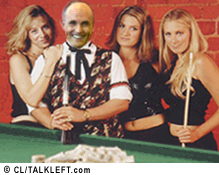
There's a six page feature article on Judith Giuliani in the new Vanity Fair which will be on the newstands this week. You can read it online now.
By the middle of the first page, you know it's going to be a train wreck for Judi. By the end of the article, there are no survivors, least of all Judi and Rudy.
Some of the juicier tidbits, like her ex-husband's allegation contained in court papers that she shouted anti-semitic insults at him and the intricate details about how, as an employee of U.S. Surgical, a company that performed live demonstrations of its surgical devices for doctors, she would have had to participate in the cruel killing of dogs, are going to seriously raise the blood pressure of Rudy's campaign staff. Others, like how her Louis Vuitton purse is so large it gets it own seat on their private plane and is nicknamed "Baby Louis" are amusing.
Mostly, she comes across as a phony, money grubbing, power-seeking wannabe.
Towards the end, there is speculation that Rudy's wandering eye is back.
The position of "Mrs. Giuliani" has not historically been a secure post. Although the candidate has lately been warned by advisers to avoid any hint of scandal, there is a sense that perhaps he is not listening. "Does a leopard change its spots?" says one close friend.
A source described as a friend of Rudy's says:
"Rudy has no willpower when it comes to relationships. This is why it's such an issue," says a Giuliani friend.
In all, it's a hatchet job but one you just can't stop reading.
Update: Wonkette's recap had me laughing out loud.
(14 comments) Permalink :: Comments
Posted on Mon Jul 30, 2007 at 09:24:49 AM EST
Tags: (all tags)
Last July, Sen. Barack Obama, speaking about Democrats and faith, said:
Democrats, for the most part, have taken the bait. At best, we may try to avoid the conversation about religious values altogether, fearful of offending anyone and claiming that - regardless of our personal beliefs - constitutional principles tie our hands. At worst, some liberals dismiss religion in the public square as inherently irrational or intolerant, insisting on a caricature of religious Americans that paints them as fanatical, or thinking that the very word "Christian" describes one's political opponents, not people of faith.
This false caricature of Democrats was bad political rhetoric. Obama improved here. And in this e-mail interview with a Christian Broadcasting Network reporter, improves again, but fails to improve in other respects:
(9 comments, 1511 words in story) There's More :: Permalink :: Comments
Jeff Toobin has a new article in the New Yorker on the unsolved murder of Washington (Seattle) Assistant U.S. Attorney Tom Wales.
After detailing the life and murder of Wales, a well-liked AUSA who was politically active in a gun safety group, Toobin connects some dots between the Justice Department's initial lack of enthusiasm for investigating the murder and the later firing of Washington U.S. Attorney John McKay, who had nudged (pressured is too strong a word) those at Main Justice to try harder to find the murderer.
There's also a suspect in the murder, and Jeff details his history as well.
It's a great read, and available free online.
Posted on Mon Jul 30, 2007 at 01:15:00 AM EST
Tags: Yearly Kos (all tags)
The San Francisco Chronicle writes up Yearly Kos and its growing influence. It makes the point that right wing sites are just not in the same league as Daily Kos and other widely read liberal blogs.
Here's all you need to know about how influential the YearlyKos convention has become: Five top presidential candidates are going....Analysts say the community of liberal online activists -- the "netroots" -- has become not only a coveted constituency for the left but a legitimate threat to conservatives, who trail Democrats in online campaigning and fundraising.
There will be 200 journalists covering Yearly Kos. The right will be criticizing, but, I suspect, speaking to their echo chamber.
The article also compares blogs in 2007 to those in 2004:
The netroots have come a long way from the 2004 Democratic National Convention, when it was big news that bloggers were given media credentials.
Most of the public didn't even know what a blog was then. We've come a long way, but it's where we're going and what we are going to do that counts.
More...
(1 comment, 381 words in story) There's More :: Permalink :: Comments
Posted on Sun Jul 29, 2007 at 10:12:06 PM EST
Tags: (all tags)
Michael O'Hanlon and Ken Pollack write:
Here is the most important thing Americans need to understand: We are finally getting somewhere in Iraq, at least in military terms. As two analysts who have harshly criticized the Bush administration’s miserable handling of Iraq, we were surprised by the gains we saw and the potential to produce not necessarily “victory” but a sustainable stability that both we and the Iraqis could live with.
As two analysts who have been cheering this war on for 4 years, who the heck do you think you are kidding? Consider this from CSM, via Sully:
(2 comments, 497 words in story) There's More :: Permalink :: Comments
This article, via Nick Beaudrot, demonstrates that James Fallows (he has a blog too) had been very good for a while now.
He discusses problems in the Media. It is from 1996. On the flip I have an extended excerpt of a small part of it that is brilliant. But read the whole thing.
(19 comments, 1257 words in story) There's More :: Permalink :: Comments
Posted on Sun Jul 29, 2007 at 08:12:21 PM EST
Tags: (all tags)
So there is a lot of teeth gnashing in the Right Blogs about the now unlikely to happen Republican You Tube Debate. I am sympathetic to a part of the complaint. I thought CNN made a joke of the Democratic You Tube Debate. I hated it. Jeralyn and just about everyone else loved it and Democrats got great press for it. Clearly it was successful for Democrats. And there is the rub for Republicans as Patrick Ruffini describes:
At the end of the day, the issue is not YouTube. The YouTube debate snub is the symptom, not the disease. If Republicans fret about a simple debate format, which is really just the modern version of the 1992 townhall debate, how in the heck are we going to be make the really bold, gutsy decisions to transform our campaigns so we can raise over $100 million online and recruit millions — yes millions — of volunteers over the Internet?
Ruffini points to this from Trippi, discussing the You Tube Debate and the pitfalls for Republicans and the Internet (starting at 2:30 or so):
More.
(9 comments, 569 words in story) There's More :: Permalink :: Comments
| << Previous 12 | Next 12 >> |