
Supreme Court Limits Miranda Warnings and Holds Incarceration May Not Be Custody
Posted on Wed Feb 24, 2010 at 11:36:00 AM EST
Tags: Miranda Warnings (all tags)



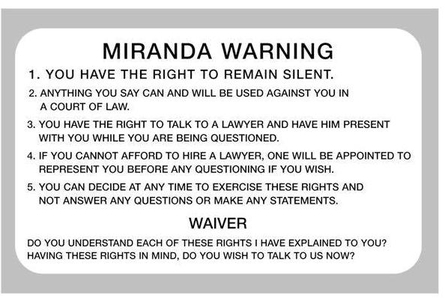
Miranda warnings are required to be given when a suspect is in a custodial setting. If the suspect invokes his right to refuse to answer questions without a lawyer, no questioning can take place. If he starts to answer questions and then asks for a lawyer, questioning must cease. If these rules aren't followed, Edwards v. Arizona allows a subsequent confession to be suppressed. Under Edwards, any subsequent waiver of Miranda rights is presumed involuntary unless the suspect, rather than the police, reinitiated questioning. The
The Supreme Court today ruled in Maryland v. Schatzer that if the suspect asks for a lawyer and is released without questioning taking place, that request is only valid for two weeks. Scotus Blog reports here and has the opinion here. The opinion is written by Justice Scalia. No one dissented, including Sotomayor, but Justices Stevens and Thomas filed their own opinions concurring in part and concurring in the judgment. [More....]
In other words, after two weeks, police can bring the suspect back into custody as if he never invoked his right to a lawyer, read him his Miranda rights again, and hope this time he answers without a lawyer.
This is an invitation to "catch and release." At some point, I would think, an individual is going to get sick of the hassle of being brought down to the station house to answer questions, particularly if they are on the job and get pulled out of work every few weeks, and just answer the questions to get it over with.
The case involved a man who was already serving a sentence. It also involved a delay of two and one half years between questioning. Yet, today the Supreme Court says it wants to give law enforcement guidance, so it sets a 14 days as the maximum period Miranda warnings are valid. To top it off, it holds that incarceration is not necessarily "in custody" for interrogation and Miranda purposes, coming up with a distinction called "interrogative custody." It reasons that since for an inmate serving a prison sentence, the prison is his home, and he can go places like the prison library, he's not in a custodial setting just because he can't leave and his home is a prison.
| < The Strange Politics Of The Excise Tax Part 2 | "And Then . . " > |