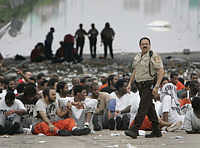
The decision to leave the prisoners behind was intentional:
In the days before the hurricane, when other citizens of New Orleans were ordered to leave, city leaders were asked: "What about the prisoners in the jail?"
"The prisoners will stay where they belong," replied Marlin Gusman, the criminal sheriff in charge of the city jail.
Most of those in the Orleans Parish Prison were there for minor offenses like unpaid fines and jaywalking. Some hadn't been charged. One third were charged but couldn't make bond and were waiting for their trials --still cloaked in innocence. After Katrina hit, violent offenders from other prisons were moved in with them.
The food and drinking water ran out. Many were in windowless cells in soaring heat. They began to riot.
Then it was determined they had to get the prisoners out:
They would have to be ferried by boats, six at a time. In the chaos some were left behind, forgotten, and some inmates reported seeing prisoners who had drowned. Andrew Joseph said he saw a body floating in the water with a rat sitting on its chest. There were reports too of other deaths.
A member of the prison staff made a sworn statement that he had removed two body-bags containing the bodies of female deputies who had died, asphyxiated by smoke from burning mattresses.
Because of Louisiana's quirky legal system, things got even worse for the prisoners:
Months after the hurricane many were still suffering the consequences of a system peculiar to Louisiana - that of funding public defence lawyers partly from traffic violations revenue. When the city flooded and the traffic stopped, the money ran out, depriving the poor of their legal rights to a defence. At one time, the city was reduced to just four defence lawyers, each with an unmanageable caseload.
It was even worse for those who had been convicted and were hoping DNA evidence not presented at trial could prove their innocence on appeal:
For those convicted of serious crimes and hoping for a reprieve, however, there were graver consequences still. Evidence tag among rubble Vital forensic evidence stored in a basement was destroyed Forensic evidence stored in the courthouse basement was destroyed, dashing hopes of justice for those wrongly convicted of rape and murder.
Bottom line:
New Orleans is notorious both for its low murder clear-up rate and its wrong convictions. But for those at the bottom of the social heap - the poorest prisoners in one of America's poorest states - Katrina brought a justice system already near to collapse, to a standstill.
If you get the BBC, I hope you will watch. Here's more on prisoners abandoned to Katrina: